
One of the most important questions is where an egress window goes. The first consideration is the building code. Once that is accounted for, the next most important issue is practicality.
Code requires every basement bedroom to have an egress window located in the room, unless the basement is a walkout basement. A walkout basement is one where a door leads either to the yard or a set of code-compliant steps that lead up to grade. Having an egress window in the bedroom qualifies any other finished (non-bedroom) area as habitable space. For example, if you have an egress window in a bedroom, you do not need one in a recreational area or theater room. You may want one for the extra light it brings, but it is not a code requirement. Likewise, an egress window anywhere in the basement qualifies all other finished space as habitable, just not as a bedroom.
People often choose an existing window for their egress window location. This is a convenient option because we stock several widths and heights of windows in order to be able to stay within the existing window width. That means nothing changes structurally by extending the opening down. However, we do not require an existing window opening. When installing with no existing opening, commonly referred to as a blind hole or virgin cut, we can drop the window opening down, leaving existing concrete overhead in order to distribute the load around the window, when appropriate.

When evaluating whether a location will work for an egress window, we have to consider both the interior and the exterior. We only need about three feet of space out from the foundation. If there are obstructions overhead, sometimes we cannot utilize our most popular window, the single-hung in-swing casement window. If the obstruction is only at the top, we can often drop the top of the window down to clear the ceiling, soffit, or pipe.
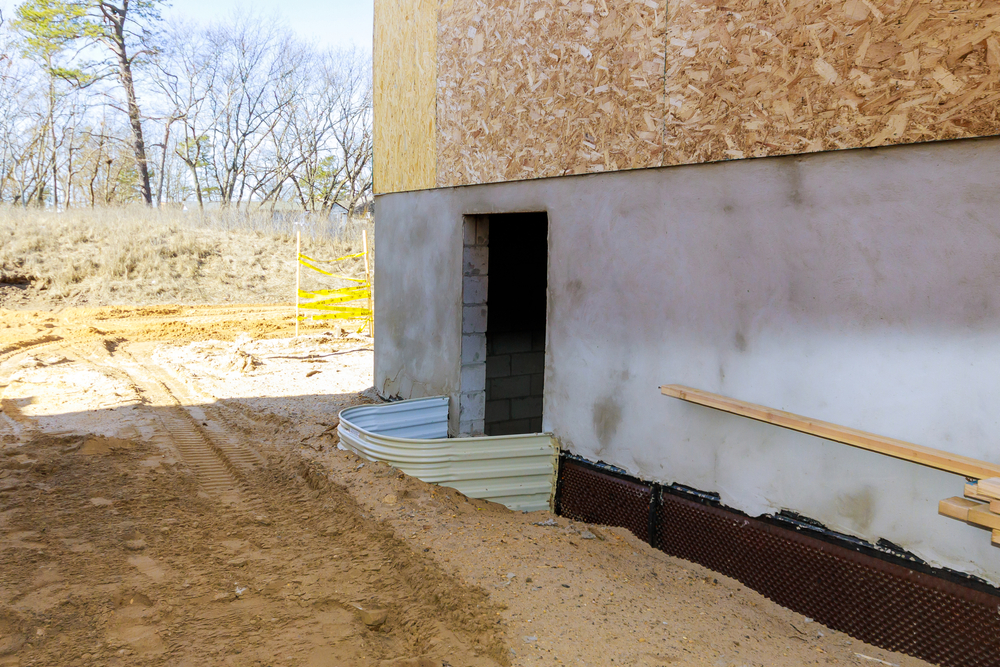
For the exterior, we are concerned with a few things. The amount of access to the area. We still offer hand digging for tight spaces, but it is slightly more expensive. The presence of trees or shrubs could indicate heavy roots in the area. Depending on window and well selection, we will need to excavate 60 inches wide, projecting 40 inches from the foundation, or 70 inches by 40.
Our main concerns are the gas, electric, and water meters. If any of those are on the same side of the house, the line may be in conflict with the excavation area. Generally speaking, gas and water lines run to the road. Water is rarely in the way because it tends to be towards the front of the house unless the egress window is being installed on the front. Even then, it isn’t typically an issue. The electric, if an underground service, will run to a green box. Most of the time, this will be towards the back of the house. Occasionally, the box will be towards the side and rarely towards the front. Older houses will often have overhead service, in which case there isn’t a wire in the ground to worry about. You can tell by looking at your electric meter. If there is a pipe going into the ground, it’s an underground service. If you see a wire coming in from above, you have an overhead service. Just because a line runs in front of the window location doesn’t necessarily mean it will be in the way. We send in OUPS requests to verify the location before ruling out a location for your new egress window installation.
Lastly, while an egress window anywhere in the basement will increase light, facing influences the amount of light. A window facing South will have direct sun for a significant portion of the day. A window facing East will enjoy morning sun, and a westward-facing egress will get more afternoon sun.